
01 / Orchestration
One control plane
An orchestrator routes work across specialist domains rather than treating every agent as an interchangeable generalist.
System architecture / engineering record
BlackBoxx.ai operates a private, modular AI environment built around specialized agents, explicit authority boundaries, human-controlled execution, and evidence that survives the demo.
Technical, not theatricalThis page separates what is operating now, what remains on the roadmap, and what has been independently acknowledged upstream. Sensitive implementation details are intentionally omitted.
Architecture
The architecture connects user intent, orchestration, specialized agents, model routing, tools, memory, infrastructure, and real-world outputs. The central design question is not only what an agent can understand, but what it is technically allowed to do.
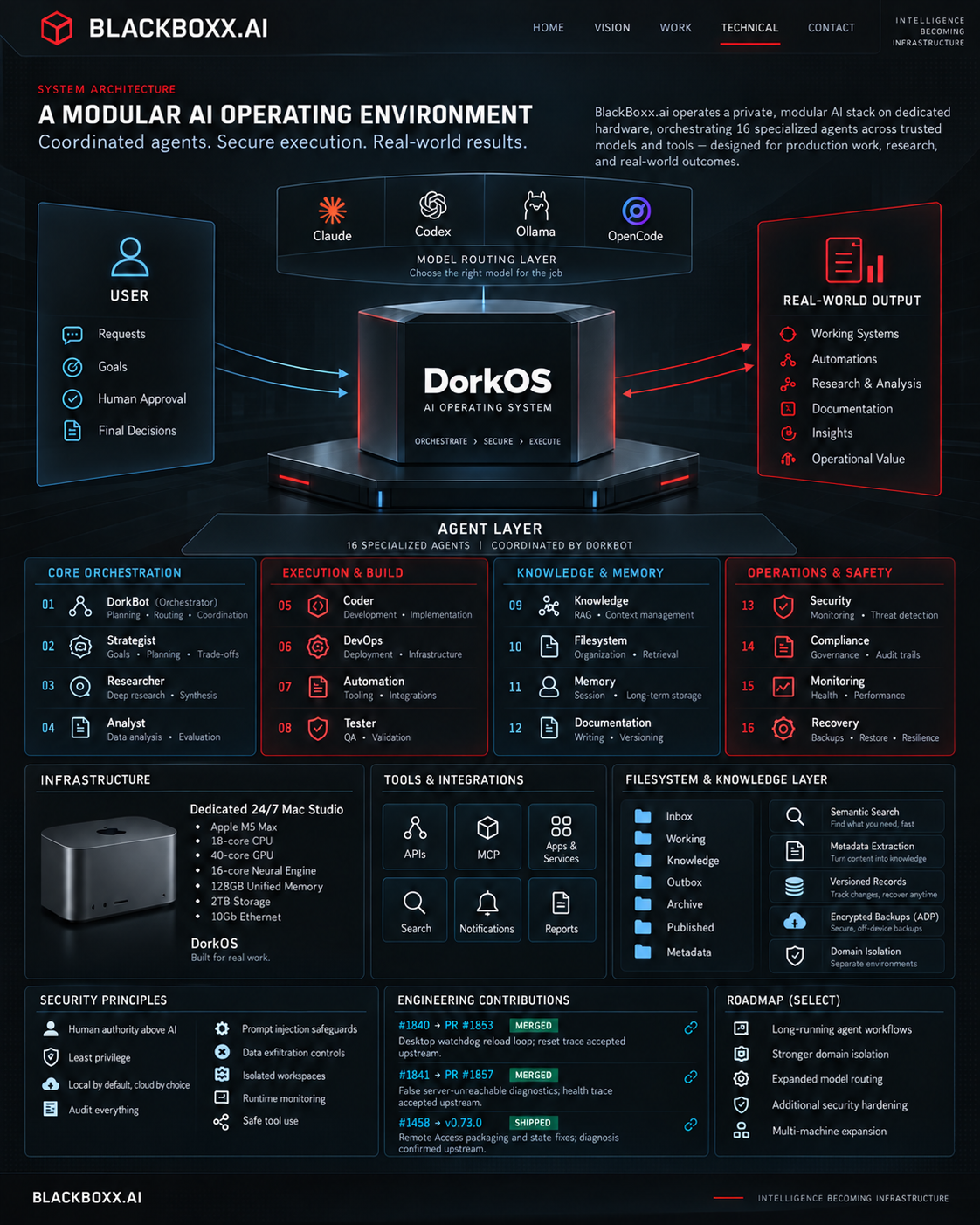
Control model
A highly capable agent can still be prevented from taking actions or crossing boundaries outside its approved envelope. That distinction is the difference between an impressive demo and infrastructure you can begin to trust with real work.
01 / Orchestration
An orchestrator routes work across specialist domains rather than treating every agent as an interchangeable generalist.
02 / Least privilege
Every non-orchestrator agent operates below an explicit ceiling that removes destructive capability classes it does not need.
03 / Directed access
Agent collaboration is allow-listed through directional rules, including one-way relationships where a domain may receive work but never initiate it.
04 / Verification
Permitted routes and expected denials are exercised live. A control that has not been challenged is not yet a verified control.
DorkOS technical bulletins
These are public, verifiable examples of BlackBoxx.ai tracing reliability defects to root cause and collaborating with the DorkOS maintainers. Statuses below reflect the public record as of September 14, 2026.
A slow first paint could become an endless 11–13 second reload cycle that destroyed unsaved operator state. The server remained healthy throughout, which meant ordinary server troubleshooting could not explain the failure.
A heartbeat from the outgoing page arrived after reload, reset the failure count, and prevented the recovery ladder from advancing.
45/45 health checks returned HTTP 200, the server and renderer processes stayed stable, and 92 cycles were traced in application logs.
PR #1853 now accepts a heartbeat only from the page the watchdog is actually waiting on. The fix is merged; release delivery is pending.
“Your trace of the reset was exactly right and turned a day of digging into an afternoon.”Dorian Collier · Creator of DorkOS
The desktop cockpit displayed “can’t reach its server” while the server was continuously reachable. That message misdirected diagnosis and trained the operator to distrust the system’s primary health indicator.
The screen was keyed to a configuration request rather than server health, and a cumulative failure counter could remain set for the life of the page.
The panel was observed while the health endpoint returned 45/45 successful responses in 1.0–5.4 milliseconds.
PR #1857 reserves “unreachable” for cases where nothing answered and reports actual server errors without guessing the cause. The fix is merged; release delivery is pending.
Remote Access failed to start because a required native binary was absent from the packaged desktop application. The visible switch then snapped back without preserving the error, while higher log levels still failed to disclose the root cause.
The per-platform ngrok package was a nested optional dependency the desktop packager never reached; separate state-sync and logging defects obscured the failure.
The upstream response expanded beyond the missing binary to persistent errors, retry behavior, restart survival, dropped-tunnel detection, and useful logging.
The combined fixes were released publicly in DorkOS v0.73.0.
“Your diagnosis was exactly right, and it saved us a lot of time.”Dorian Collier · Creator of DorkOS
State of the system
Credibility depends on keeping that line visible.
Operating now
Roadmap / select
Emerging infrastructure
Programmable namespaces may become useful infrastructure for agent identity, authentication, delegated access, and continuity. BlackBoxx.ai is participating early while keeping exploratory work distinct from operating systems.
01 / Strategic namespaces
BlackBoxx.ai founder Karl Ohlemann owns a strategically selected portfolio of 23 Web3 top-level domains through Freename, all minted on Polygon, including .blackboxx and .moonvault. These assets are being evaluated as programmable namespaces; they are not presented as production infrastructure today.
02 / Ecosystem access
Karl is a Freename VIP client and early product-feedback participant, with direct access to product, engineering, and executive teams through private previews, workshops, roadmap discussions, and feedback sessions. This is emerging-infrastructure participation and technology ecosystem access—not a claim of a formal partnership.
Open systems / real use
DorkOS is open-source software released under the MIT License. BlackBoxx.ai is an independent user and contributor, not DorkOS or its maintainer.